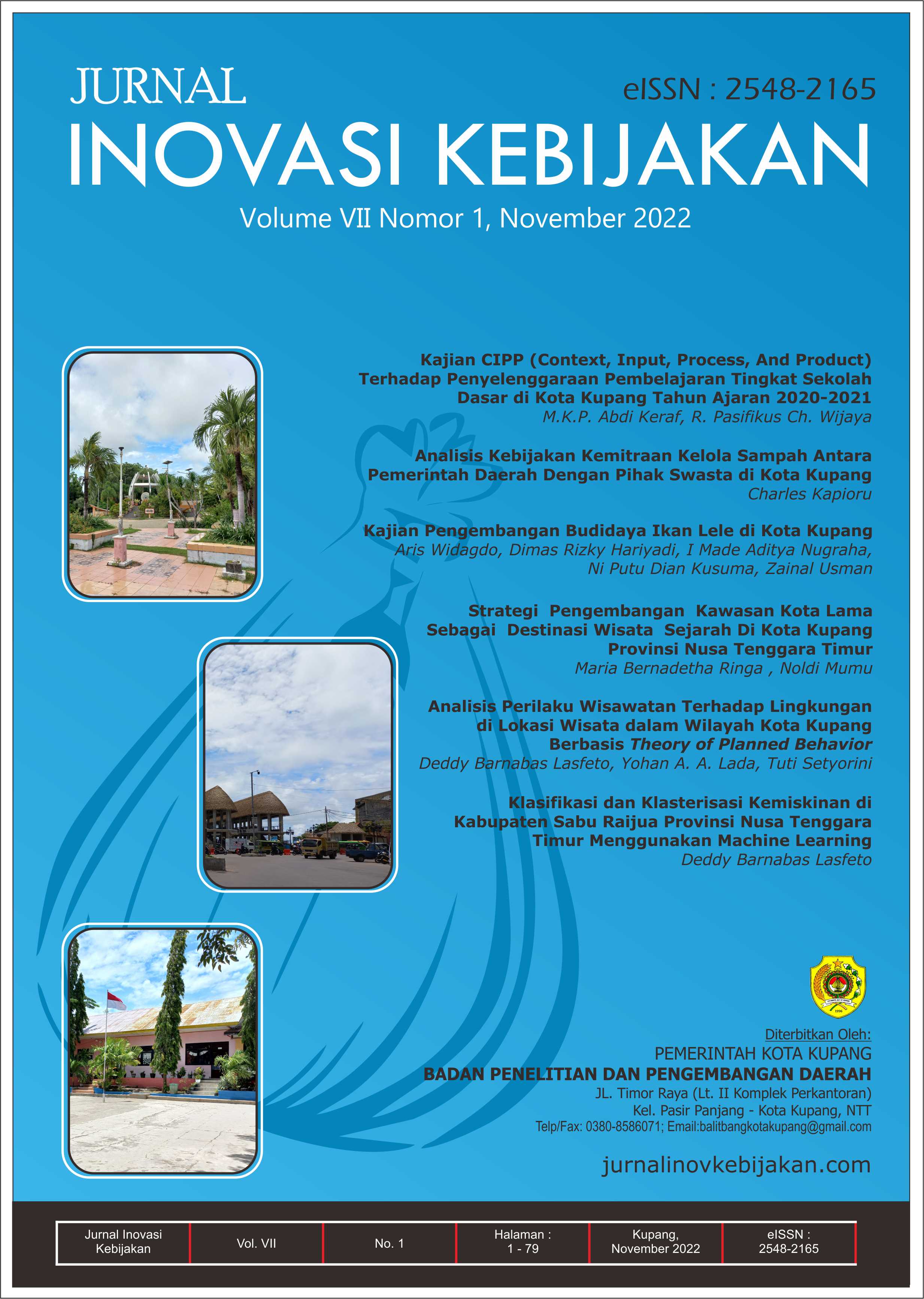
Poverty Classification and Clusterization in Sabu Raijua District, East Nusa Tenggara Province Using Machine Learning
Keywords:
society, poverty, data clusterization, data classification, machine learningAbstract
The scope of this paper is focused on the socio-economy poverty problem in rural area. Household expenditure and income surveys provide data that are used for identifying and measuring the poverty status of households. The contribution of this work is the machine learning approach to assess and monitor the poverty status of households in the rural area of Indonesia. This approach takes into account all the household expenditure and income surveys that took place. This approach is accurate, inexpensive, and makes poverty identification cheaper and much closer to real-time. Data preprocessing and handling imbalanced data are major parts of this work. machine learning classification and clustering models are applied. The final machine learning classification and clustering model could transform efforts to track and target poverty. This work demonstrates how powerful and versatile machine learning can be, and hence, it promotes for adoption across many domains in both the private sector and government.
Downloads
References
Asian Development Bank. (2021). Mapping the Spatial Distribution of Poverty Using Satellite Imagery in Thailand (Issue April).
Badan Pusat Statistik. (2021). Data dan Informasi Kemiskinan Kabupaten/Kota tahun 2021.
Pemerintah Kabupaten Sabu Raijua. (2021). Rencana Pembangunan Jangka Menengah Daerah tahun 2021 - 2026.
Hahn, P. (2019). Artificial intelligence and machine learning. Handchirurgie Mikrochirurgie Plastische Chirurgie, 51(1), 62–67. https://doi.org/10.1055/a-0826-4789
Alsharkawi, A., Al-Fetyani, M., Dawas, M., Saadeh, H., & Alyaman, M. (2021). Poverty classification using machine learning: The case of Jordan. Sustainability (Switzerland), 13(3), 1–16. https://doi.org/10.3390/su13031412
Effendy, F., & Purbandini, P. (2018). Klasifikasi Rumah Tangga Miskin Menggunakan Ordinal Class Classifier. Jurnal Nasional Teknologi Dan Sistem Informasi, 4(1), 30–36. https://doi.org/10.25077/teknosi.v4i1.2018.30-36
Nofriani, N. (2020). Machine Learning Application for Classification Prediction of Household’s Welfare Status. JITCE (Journal of Information Technology and Computer Engineering), 4(02), 72–82. https://doi.org/10.25077/jitce.4.02.72-82.2020
Poreddy, D., Reddy, E. V. V., Prasad, S. V., & Reddy, K. A. (2020). Classification of Poverty Levels Using Machine Learning. Journal of Xi’an University of Architecture & Technology, 12(4), 5723–5728.
Sihombing, P. R., & Arsani, A. M. (2021). Comparison of Machine Learning Methods in Classifying Poverty in Indonesia in 2018. Jurnal Teknik Informatika (Jutif), 2(1), 51–56. https://doi.org/10.20884/1.jutif.2021.2.1.52
Rozenberg, J., & Hallegatte, S. (2016). Model and Methods for Estimating the Number of People Living in Extreme Poverty Because of the Direct Impacts of Natural Disasters. Model and Methods for Estimating the Number of People Living in Extreme Poverty Because of the Direct Impacts of Natural Disasters, November. https://doi.org/10.1596/1813-9450-7887
Mustapha Ibrahim, D., & Ren, D. (2021). Nigeria Poverty Analysis, Prediction Using Machine Learning Methods and Deep Learning. Asian Journal of Social Sciences, Arts and Humanities, 9(1), 2021. www.multidisciplinaryjournals.com
Alsharkawi, A., Al-Fetyani, M., Dawas, M., Saadeh, H., & Alyaman, M. (2021). Poverty classification using machine learning: The case of Jordan. Sustainability (Switzerland), 13(3), 1–16. https://doi.org/10.3390/su13031412
Ayush, K., Uzkent, B., Tanmay, K., Burke, M., Lobell, D., & Ermon, S. (2020). Efficient Poverty Mapping using Deep Reinforcement Learning. http://arxiv.org/abs/2006.04224
Huang, L. Y., Hsiang, S., & Gonzalez-Navarro, M. (2021). Using Satellite Imagery and Deep Learning to Evaluate the Impact of Anti-Poverty Programs. SSRN Electronic Journal, 1–37. https://doi.org/10.2139/ssrn.3897541
Jiang, Y., Zhang, L., Li, Y., Lin, J., Li, J., Zhou, G., Liu, S., Cao, J., & Xiao, Z. (2021). Evaluation of county-level poverty alleviation progress by deep learning and satellite observations. Big Earth Data, 5(4), 576–592
The SMERU Research Institute. (2016). Penetapan Kriteria dan Variabel Pendataan Penduduk Miskin yang Komprehensif dalam Rangka Perlindungan Penduduk Miskin di Kabupaten/Kota.
Downloads
Published
Issue
Section
License
Copyright (c) 2022 Jurnal Inovasi Kebijakan

This work is licensed under a Creative Commons Attribution-NonCommercial-ShareAlike 4.0 International License.
Copyright Notice
An author who publishes in the Jurnal Inovasi Kebijakan agrees to the following terms:
- Author retains the copyright and grants the journal the right of first publication of the work simultaneously licensed under the Creative Commons Attribution-ShareAlike 4.0 License that allows others to share the work with an acknowledgement of the work's authorship and initial publication in this journal
- Author is able to enter into separate, additional contractual arrangements for the non-exclusive distribution of the journal's published version of the work (e.g., post it to an institutional repository or publish it in a book) with the acknowledgement of its initial publication in this journal.
- Author is permitted and encouraged to post his/her work online (e.g., in institutional repositories or on their website) prior to and during the submission process, as it can lead to productive exchanges, as well as earlier and greater citation of the published work (See The Effect of Open Access).
Read more about the Creative Commons Attribution-ShareAlike 4.0 Licence here: https://creativecommons.org/licenses/by-sa/4.0/.