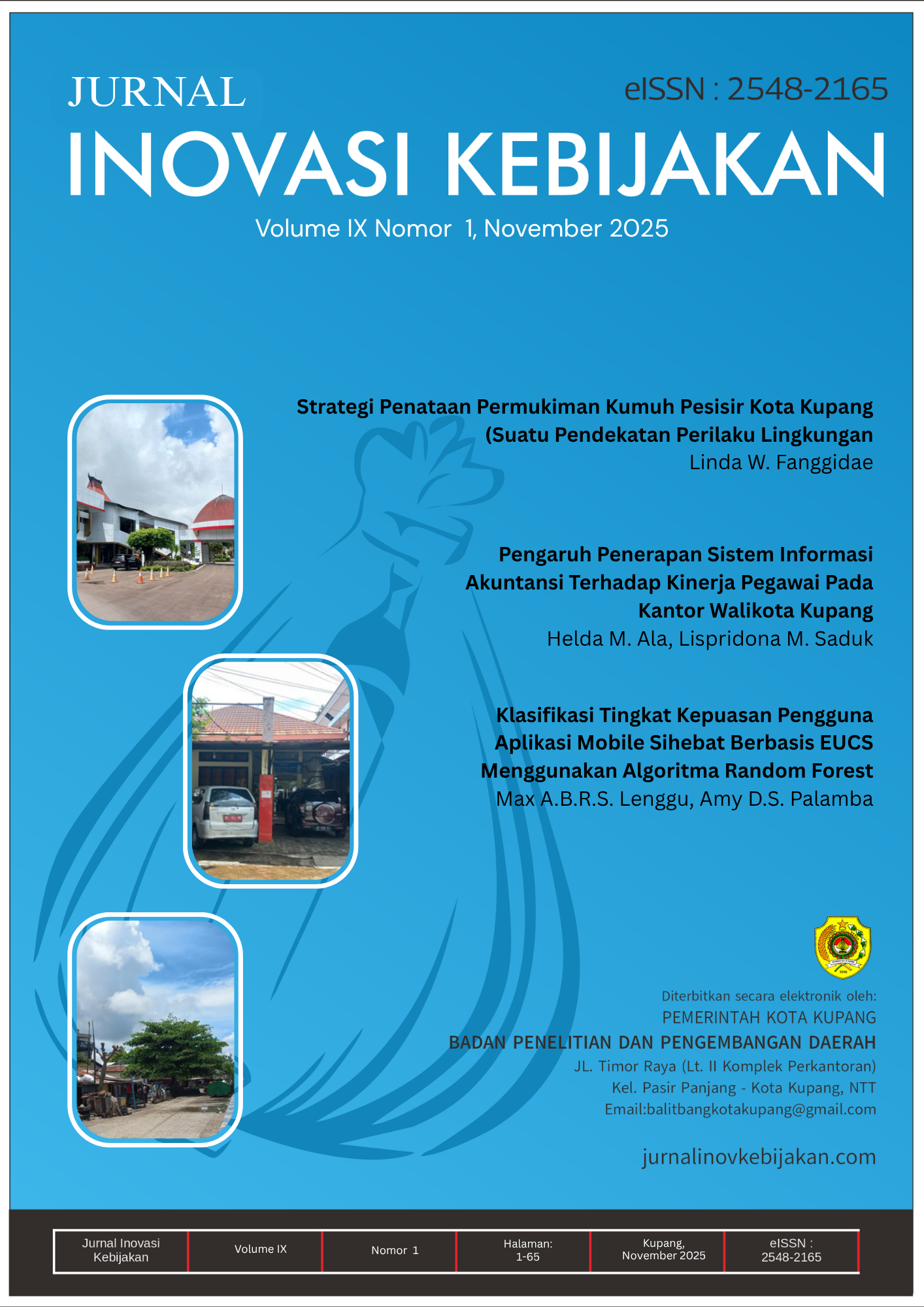
Classification of User Satisfaction Level of Sihebat Mobile Application Using Random Forest Algorithm
DOI:
https://doi.org/10.37182/3js4yh85Keywords:
SIHEBAT EUCS, Random Forest Classification, Model User Satisfaction, PredictionAbstract
The SIHEBAT (Fuel Efficiency Information System) mobile application was developed by the Kupang City Communication and Information Agency to optimize the fuel budget for official vehicles. The successful implementation of this system requires periodic evaluation of end-user satisfaction. This study aims to (1) analyze user satisfaction levels based on five dimensions of End User Computing Satisfaction (EUCS)—Content, Accuracy, Ease of Use, Format, and Timeliness—and (2) Develop a predictive model of user satisfaction scores using the Random Forest Regression algorithm.. Data were collected through an online questionnaire from 30 vehicle managers and 150 application users within the Kupang City Government. Initial EUCS analysis shows that user satisfaction is at a very satisfied level for Content (97.0%), Format (86.9%), and Accuracy (86.4%). However, improvements are still needed in Ease of Use (78.3%) and Timeliness (76.6%), indicating challenges in interface usability and system responsiveness. For predictive modeling, EUCS variables were used as input features to estimate the overall satisfaction score (numerical value). The Random Forest Regression model was selected due to its ability to handle nonlinear relationships and identify the most influential variables. The evaluation results show excellent predictive performance with a Mean Squared Error (MSE) of 0.02, Root Mean Squared Error (RMSE) of 0.14, and R² of 0.9982. These results indicate that Ease of Use and Timeliness are the most critical predictors of user satisfaction. This model provides a valid and data-driven tool for the Kupang City Communication and Information Agency to prioritize system improvements based on factors that significantly influence user satisfaction.
Downloads
References
M. Al-hader, A. Rodzi, and N. Ahmad, ―Smart City Components Architecture,‖ pp. 93 97, 2009, doi: 10.1109/CSSim.2009.34.
M. Balduccini, E. Griffor, M. Huth, C. Vishik, M. Burns, and D. Wollman, ―Reasoning about Smart City,‖ pp. 381–386, 2018, doi: 10.1109/SMARTCOMP.2018.00033.
A. Raj, ―Smart parking systems technologies, tools, and challenges for implementing in a smart city environment: a survey based on IoT & ML perspective,‖ Int. J. Mach. Learn. Cybern., vol. 15, no. 7, pp. 2673–2694, 2024, doi: 10.1007/s13042-023-02056-5.
P. Aplikasi, E. D. Rangka, P. Bahan, B. Minyak, D. Lingkungan, and K. Kupang, ―Jurnal inovasi kebijakan,‖ vol. VI, pp. 39–54, 2021.
M. Nithya and A. Gokulakrishnan, ―Measuring E Customer Satisfaction in Online Retail A Comparative Analysis Using Various ML Algorithms,‖ 2024 2nd Int., 2024, [Online]. Available: https://ieeexplore.ieee.org/abstract/document/10912390/
P. latha Soundarraj, P. Jayaraj, S. Meetna, and ―Prioritizing Factors Affecting Customers Satisfaction in the Internet Banking Using Artificial Intelligence,‖ 2024, researchgate.net. [Online]. Available: https://www.researchgate.net/profile/Syed-Naqvi- 98/publication/381825230_Prioritizing_Factors_Affecting_Customers_Satisfaction_in_th e_Internet_Banking_Using_Artificial_Intelligence/links/66bdf3e5145f4d35535cc88d/Prio ritizing-Factors-Affecting-Customers
J. Informatika and E. Bisnis, ―Jurnal Informatika Ekonomi Bisnis End-User Computing Satisfaction dalam Menganalisis Tingkat Kepuasan Pengguna Sistem Informasi Akademik,‖ vol. 4, pp. 5–9, 2022, doi: 10.37034/infeb.v4i3.150.
R. Pandey, P. K. Patidar, P. Verma, and , ―A Comparative Study of Random Forest, SVM, and Naive Bayes for Sentiment Analysis Optimization,‖ 2024 IEEE 2nd 2024, [Online]. Available: https://ieeexplore.ieee.org/abstract/document/10959957/
M. JANAH, C. Adipradana, M. S. Nidhom, and "PENGGUNA SISTEM INFORMASI KEARSIPAN DINAMIS TERINTEGRITASI (SRIKANDI) MENGGUNAKAN METODE END USER COMPUTING SATISFACTION,‖ J. Compos, 2025, [Online]. Available: https://ojs.shahida.or.id/index.php/composite/article/view/64 [10]
Y. D. Anahyu, ―Analisis Kepuasan Pengguna Akhir Aplikasi Mytelkomsel Menggunakan Metode End User Computing Satisfaction (EUCS),‖ J. INOVTEK POLBENG-SERI 2024, [Online]. Available: http://repository.uin-suska.ac.id/82242/ [11]
T. Hayes, A. N. Baraldi, and S. Coxe, ―Random forest analysis and lasso regression outperform traditional methods in identifying missing data auxiliary variables when the MAR mechanism is nonlinear ‖ Behav. Res. Methods, 2024, doi: 10.3758/s13428-024 02494-1. [12]
P. Monica and A. R. Patta, ―Implementatiton of the Random Forest Regression Algorithm for Predicting Maize Yields,‖ J. Embed. Syst. Secur. 2025, [Online]. Available: https://journal.unm.ac.id/index.php/JESSI/article/view/9540
Downloads
Published
Issue
Section
License
Copyright (c) 2025 Jurnal Inovasi Kebijakan

This work is licensed under a Creative Commons Attribution-NonCommercial-ShareAlike 4.0 International License.
Copyright Notice
An author who publishes in the Jurnal Inovasi Kebijakan agrees to the following terms:
- Author retains the copyright and grants the journal the right of first publication of the work simultaneously licensed under the Creative Commons Attribution-ShareAlike 4.0 License that allows others to share the work with an acknowledgement of the work's authorship and initial publication in this journal
- Author is able to enter into separate, additional contractual arrangements for the non-exclusive distribution of the journal's published version of the work (e.g., post it to an institutional repository or publish it in a book) with the acknowledgement of its initial publication in this journal.
- Author is permitted and encouraged to post his/her work online (e.g., in institutional repositories or on their website) prior to and during the submission process, as it can lead to productive exchanges, as well as earlier and greater citation of the published work (See The Effect of Open Access).
Read more about the Creative Commons Attribution-ShareAlike 4.0 Licence here: https://creativecommons.org/licenses/by-sa/4.0/.