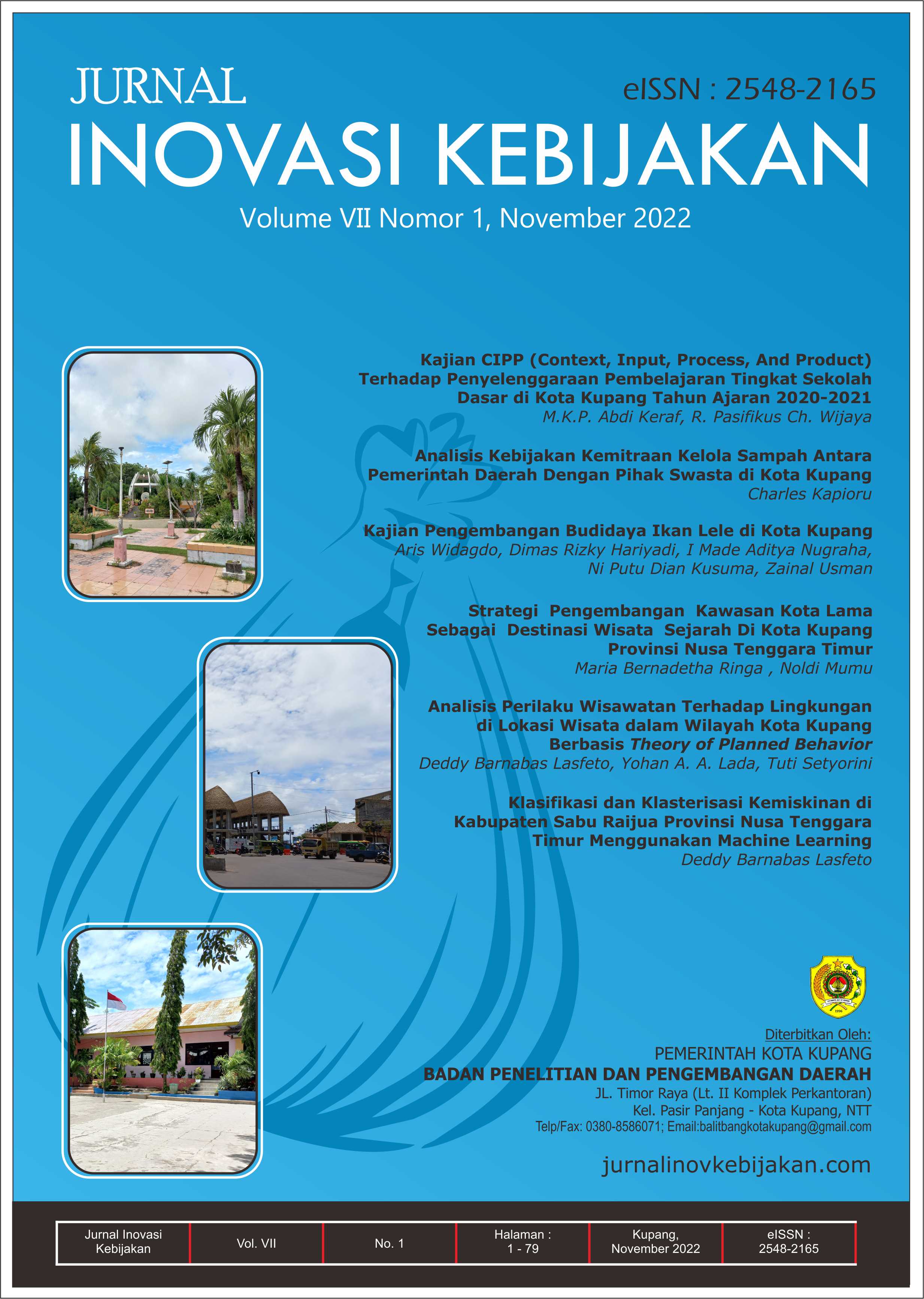
Analysis of Tourist Behaviour towards The Environment at Tourist Sites in Kupang City Based on The Theory of Planned Behaviour
Keywords:
environmentally responsible behaviour, traveller, theory of planned behaviour, level of educationAbstract
This study discusses the impact of external factors at tourist sites on tourist environmental behaviour. The tourists in this study were students in Kupang City. The multiple-group analysis function was used to make comparisons of the education levels of student tourists at tourist spots to test the moderating effect of education levels. Through analysis of survey data collected from tourists at several tourist sites in the city of Kupang, it is recommended to encourage the formation of good communities in supporting environmentally responsible behaviour in tourist attractions. This finding also confirms that education level moderates the relationship between tourist intentions and actual environmentally responsible behaviour.
Downloads
References
Ahrens, R. de B., Lirani, L. da S., & de Francisco, A. C. (2020). Construct validity and reliability of the work environment assessment instrument WE-10. International Journal of Environmental Research and Public Health, 17(20), 1–19. https://doi.org/10.3390/ijerph17207364
Ajzen, I. (2019). Constructing a Theory of Planned Behaviour.
Alam, M. A., Chamroonsawasdi, K., Chansatitporn, N., Munsawaengsub, C., & Islam, M. S. (2018). Regional variations of fertility control behavior among rural reproductive women in Bangladesh: A hierarchical analysis. Behavioral Sciences, 8(8). https://doi.org/10.3390/bs8080068
Assaker, G. (2011). Insights into tourism demand and tourism behavior: Four papers using multiple perspectives and structural equation modeling. European Journal of Tourism Research, 4(2), 237–241.
Assaker, G., Vinzi, V. E., & O’connor, P. (2011). Extending a tourism causality network model: A cross-country, multigroup empirical analysis. Tourism and Hospitality Research, 11(4), 258–277. https://doi.org/10.1177/1467358411418815
Bronfman, N. C., Cisternas, P. C., López-Vázquez, E., De la Maza, C., & Oyanedel, J. C. (2015). Understanding attitudes and pro-environmental behaviors in a Chilean community. Sustainability (Switzerland), 7(10), 14133–14152. https://doi.org/10.3390/su71014133
Casaló, L. V., & Escario, J. J. (2018). Heterogeneity in the association between environmental attitudes and pro-environmental behavior: A multilevel regression approach. Journal of Cleaner Production, 175, 155–163. https://doi.org/10.1016/j.jclepro.2017.11.237
Champahom, T., Jomnonkwao, S., Satiennam, T., Suesat, N., & Ratanavaraha, V. (2019). Modeling of safety helmet use intention among students in urban and rural Thailand based on the theory of planned behavior and Locus of Control. Social Science Journal. https://doi.org/10.1016/j.soscij.2019.02.003
Collier, J. E. (2020). Applied Structural Equation Modeling Using AMOS. Applied Structural Equation Modeling Using AMOS. https://doi.org/10.4324/9781003018414
Connell, J. P. (1987). Structural Equation Modeling Using AMOS. Division of Statistics and Science Computations, 58(1), 167. Retrieved from https://stat.utexas.edu/images/SSC/Site/AMOS_Tutorial.pdf
Daxini, A., Ryan, M., O’Donoghue, C., & Barnes, A. P. (2019). Understanding farmers’ intentions to follow a nutrient management plan using the theory of planned behaviour. Land Use Policy, 85(April), 428–437. https://doi.org/10.1016/j.landusepol.2019.04.002
Deng, J., Sun, P., Zhao, F., Han, X., Yang, G., & Feng, Y. (2016). Analysis of the ecological conservation behavior of farmers in payment for ecosystem service programs in eco-environmentally fragile areas using social psychology models. Science of the Total Environment, 550, 382–390. https://doi.org/10.1016/j.scitotenv.2016.01.152
Dewberry, C., & Jackson, D. J. R. (2018). An application of the theory of planned behavior to student retention. Journal of Vocational Behavior, 107, 100–110. https://doi.org/10.1016/j.jvb.2018.03.005
Dunn, R., Hattie, J., & Bowles, T. (2018). Using the Theory of Planned Behavior to explore teachers’ intentions to engage in ongoing teacher professional learning. Studies in Educational Evaluation, 59(December 2017), 288–294. https://doi.org/10.1016/j.stueduc.2018.10.001
Han, H. (2015). Travelers’ pro-environmental behavior in a green lodging context: Converging value-belief-norm theory and the theory of planned behavior. Tourism Management, 47, 164–177. https://doi.org/10.1016/j.tourman.2014.09.014
Han, H., Jae, M., & Hwang, J. (2016). Cruise travelers’ environmentally responsible decision-making: An integrative framework of goal-directed behavior and norm activation process. International Journal of Hospitality Management, 53, 94–105. https://doi.org/10.1016/j.ijhm.2015.12.005
Hoffmann, R., & Muttarak, R. (2015). Explaining the link between education and green behavior in the Philippines?: The role of knowledge and climate change perception, 1–13.
Imran, S., Alam, K., & Beaumont, N. (2014). Environmental orientations and environmental behaviour: Perceptions of protected area tourism stakeholders. Tourism Management, 40, 290–299. https://doi.org/10.1016/j.tourman.2013.07.003
Japutra, A., Loureiro, S. M. C., Molinillo, S., & Ekinci, Y. (2019). Travellers’ mindsets and theory of planned behaviour. Tourism Management Perspectives, 30(February), 193–196. https://doi.org/10.1016/j.tmp.2019.02.011
Lee, C. J., Geiger-Brown, J., & Beck, K. H. (2016). Intentions and willingness to drive while drowsy among university students: An application of an extended theory of planned behavior model. Accident Analysis and Prevention, 93(2016), 113–123. https://doi.org/10.1016/j.aap.2016.05.002
Li, J., Zuo, J., Cai, H., & Zillante, G. (2018). Construction waste reduction behavior of contractor employees: An extended theory of planned behavior model approach. Journal of Cleaner Production, 172, 1399–1408. https://doi.org/10.1016/j.jclepro.2017.10.138
Liobikiene, G., Mandravickaite, J., & Bernatoniene, J. (2016). Theory of planned behavior approach to understand the green purchasing behavior in the EU: A cross-cultural study. Ecological Economics, 125, 38–46. https://doi.org/10.1016/j.ecolecon.2016.02.008
Mainzer, S., & Luloff, A. E. (2017). Informing environmental problems through field analysis: Toward a community landscape theory of pro-environmental behavior. Community Development, 48(4), 483–498. https://doi.org/10.1080/15575330.2017.1325918
Mak, T. M. W., Yu, I. K. M., Wang, L., Hsu, S. C., Tsang, D. C. W., Li, C. N., … Poon, C. S. (2019). Extended theory of planned behaviour for promoting construction waste recycling in Hong Kong. Waste Management, 83, 161–170. https://doi.org/10.1016/j.wasman.2018.11.016
Miller, D., Merrilees, B., & Coghlan, A. (2015). Sustainable urban tourism: understanding and developing visitor pro-environmental behaviours. Journal of Sustainable Tourism, 23(1), 26–46. https://doi.org/10.1080/09669582.2014.912219
Mufaridah, L., & Handayani, D. (2014). He Relationship Between The Level Of Knowledge And Attitudes With The Behavior Of Waste Management In Housewives In The Rural Village Of Sidoarjo Abstract?: Garbage is the result of human activities that have lost their main function and are solid . Waste.
Ntanos, S., Kyriakopoulos, G. L., Arabatzis, G., Palios, V., & Chalikias, M. (2018). Environmental behavior of secondary education students: A case study at central Greece. Sustainability (Switzerland), 10(5), 1–22. https://doi.org/10.3390/su10051663
Pan, J. Y., & Truong, D. (2018). Passengers’ intentions to use low-cost carriers: An extended theory of planned behavior model. Journal of Air Transport Management, 69(February), 38–48. https://doi.org/10.1016/j.jairtraman.2018.01.006
Potard, C., Kubiszewski, V., Camus, G., Courtois, R., & Gaymard, S. (2018). Driving under the influence of alcohol and perceived invulnerability among young adults: An extension of the theory of planned behavior. Transportation Research Part F: Traffic Psychology and Behaviour, 55, 38–46. https://doi.org/10.1016/j.trf.2018.02.033
Runhaar, P., Wagenaar, K., Wesselink, R., & Runhaar, H. (2019). Encouraging Students’ Pro-environmental Behaviour: Examining the Interplay Between Student Characteristics and the Situational Strength of Schools. Journal of Education for Sustainable Development, 13(1), 45–66. https://doi.org/10.1177/0973408219840544
Sanz-Blas, S., Carvajal-Trujillo, E., & Buzova, D. (2019). The moderating effect of personal and situational characteristics in behavioural factors affecting ports of call. Current Issues in Tourism, 22(2), 133–141. https://doi.org/10.1080/13683500.2017.1369013
Schmidt, K. (2019). Predicting the consumption of expired food by an extended Theory of Planned Behavior. Food Quality and Preference, 78, 103746. https://doi.org/10.1016/j.foodqual.2019.103746
Shafiei, A., & Maleksaeidi, H. (2020). Pro-environmental behavior of university students: Application of protection motivation theory. Global Ecology and Conservation, 22. https://doi.org/10.1016/j.gecco.2020.e00908
Sullman, M. J. M., Hill, T., & Stephens, A. N. (2018). Predicting intentions to text and call while driving using the theory of planned behaviour. Transportation Research Part F: Traffic Psychology and Behaviour, 58, 405–413. https://doi.org/10.1016/j.trf.2018.05.002
Tanwir, N. S., & Hamzah, M. I. (2020). Predicting purchase intention of hybrid electric vehicles: Evidence from an emerging economy. World Electric Vehicle Journal, 11(2). https://doi.org/10.3390/WEVJ11020035
Tikka, P. M., Kuitunen, M. T., & Tynys, S. M. (2000). Effects of educational background on students’ attitudes, activity levels, and knowledge concerning the environment. Journal of Environmental Education, 31(3), 12–19. https://doi.org/10.1080/00958960009598640
Wang, C., Zhang, J., Yu, P., & Hu, H. (2018). The theory of planned behavior as a model for understanding tourists’ responsible environmental behaviors: The moderating role of environmental interpretations. Journal of Cleaner Production, 194, 425–434. https://doi.org/10.1016/j.jclepro.2018.05.171
Yang, H., Liu, X., Su, F., Cherry, C., Liu, Y., & Li, Y. (2018). Predicting e-bike users’ intention to run the red light: An application and extension of the theory of planned behavior. Transportation Research Part F: Traffic Psychology and Behaviour, 58, 282–291. https://doi.org/10.1016/j.trf.2018.05.027
Zachariou, F., Voulgari, I., Tsami, E., & Bersimis, S. (2019). Exploring the Attitudes of Secondary Education Students on Environmental Education in Relation to their Perceptions on Environmental Problems: The Case of the Prefecture of Viotia. Interdisciplinary Journal of Environmental and Science Education, 16(1), 1–13. https://doi.org/10.29333/ijese/6442
Zamani-Miandashti, N., Memarbashi, P., & Khalighzadeh, P. (2013). The prediction of internet utilization behavior of undergraduate agricultural students: An application of the theory of planned behavior. International Information and Library Review, 45(3–4), 114–126. https://doi.org/10.1016/j.iilr.2013.10.003
Zhang, L., & Ma, W. (2011). Correlation analysis between users’ educational level and mobile reading behavior. Library Hi Tech, 29(3), 424–435. https://doi.org/10.1108/07378831111174396
Downloads
Published
Issue
Section
License
Copyright (c) 2022 Jurnal Inovasi Kebijakan

This work is licensed under a Creative Commons Attribution-NonCommercial-ShareAlike 4.0 International License.
Copyright Notice
An author who publishes in the Jurnal Inovasi Kebijakan agrees to the following terms:
- Author retains the copyright and grants the journal the right of first publication of the work simultaneously licensed under the Creative Commons Attribution-ShareAlike 4.0 License that allows others to share the work with an acknowledgement of the work's authorship and initial publication in this journal
- Author is able to enter into separate, additional contractual arrangements for the non-exclusive distribution of the journal's published version of the work (e.g., post it to an institutional repository or publish it in a book) with the acknowledgement of its initial publication in this journal.
- Author is permitted and encouraged to post his/her work online (e.g., in institutional repositories or on their website) prior to and during the submission process, as it can lead to productive exchanges, as well as earlier and greater citation of the published work (See The Effect of Open Access).
Read more about the Creative Commons Attribution-ShareAlike 4.0 Licence here: https://creativecommons.org/licenses/by-sa/4.0/.